NinoGaming Perya Payout Rates and Multiplier Tables
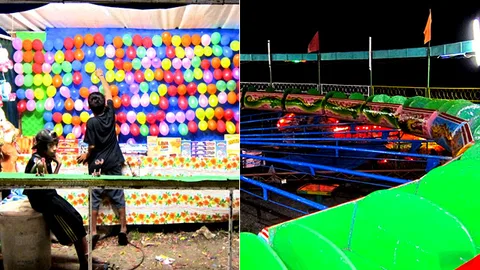
Philippine fiesta carnivals have filled village plazas with bright lights and cheering crowds for over a century. The colorful board with tumbling wooden cubes remains the undisputed centerpiece of every fiesta perya night.
Many players believe that picking a favorite color is an equal toss-up against the booth operator. When you examine the actual permutations of three six-sided cubes, the real mathematical framework reveals a steady house advantage.
The Probability Space of Three Six-Sided Colored Dice
To understand carnival returns, we have to count every possible way three colored cubes can settle after dropping through an overhead funnel. Each die possesses six distinct colored faces: red, blue, green, yellow, white, and pink.
When the operator pulls the release cord, all three wooden cubes tumble together through obstacles before resting in the collection tray below. Because each die functions as an independent physical object, their combination totals follow basic combinatorial laws.
Total Permutations Across Three Cubes: Six Cubed Equals Two Hundred Sixteen
The total number of combined outcomes is calculated by multiplying the six faces of the first die by the six faces of the second die and the six faces of the third die. This simple calculation gives exactly six cubed or two hundred sixteen unique combinations.
Every single drop of the three cubes produces one of these two hundred sixteen distinct results with equal likelihood. No single color has a magnetic attraction or mechanical preference on a balanced set of dice.
If you wager ₱100 on yellow, your financial result depends entirely on how many of those three resting cubes show yellow on their top face. Let us examine the exact count of winning and losing outcomes among the two hundred sixteen possible rolls.
The Exact Distribution of Zero, One, Two, and Three Matches
Out of two hundred sixteen combinations, exactly one hundred twenty-five rolls contain zero matching faces for your chosen color. That means in 57.87 percent of all drops, the operator rakes in your entire stake.
Next, exactly seventy-five combinations contain exactly one matching face of your selected hue. These single matches occur in 34.72 percent of total rolls and return your original wager plus a 1:1 payout of ₱100 profit.
Moving up to double hits, exactly fifteen combinations show two matching dice displaying your color. These favorable doubles occur in 6.94 percent of rolls and reward you with a 2:1 payout of ₱200 clean profit.
Finally, there is only one solitary combination where all three cubes land on your chosen color. That perfect triple match happens with a microscopic frequency of 0.46 percent, delivering a 3:1 reward of ₱300 profit.
| Dice Match Outcome | Combinations (out of 216) | Percentage Probability | Standard Payout Rate |
|---|---|---|---|
| Zero Matches (Loss) | 125 / 216 | 57.87% | Loses Entire Wager |
| Single Match (Win) | 75 / 216 | 34.72% | 1:1 Even Money (+1x) |
| Double Match (Win) | 15 / 216 | 6.94% | 2:1 Payout (+2x) |
| Triple Match (Jackpot) | 1 / 216 | 0.46% | 3:1 Payout (+3x) |
Mathematical Breakdown of the Standard Seven Point Eight Seven Percent House Edge
Many carnival visitors mistakenly believe the game is completely balanced because the operator pays bonus multiples on double and triple faces. They imagine that a triple match paying triple money compensates for the rounds where the color misses.
Calculating the true expected monetary value reveals why this intuitive assumption is completely wrong. Let us trace what happens when you place a ₱1 bet across all two hundred sixteen theoretical outcomes.
Why Equal Odds on One-to-One Matches Still Favor the House
On the one hundred twenty-five rolls where your color fails to show, you lose your ₱1 stake, creating a net loss of minus ₱125. This forms the foundational profit engine for the carnival booth operator.
On the seventy-five rolls where exactly one die matches, you gain ₱1 in profit, adding plus ₱75 to your balance. On the fifteen rolls where two dice match, you collect ₱2 each, adding plus ₱30 in gross winnings.
On the single roll where all three dice match your hue, you collect ₱3, adding plus ₱3 to your total return. When you add all winning returns together, you collect seventy-five plus thirty plus three, which equals exactly plus ₱108.
Comparing your one hundred eight pesos in total winnings against your one hundred twenty-five pesos in total losses reveals an unavoidable shortfall. You finish with a net deficit of minus ₱17 across two hundred sixteen trials.
How Non-Matching Roll Frequencies Drive Casino Revenue
Dividing that seventeen-peso loss by two hundred sixteen total combinations yields a net expectation of minus 0.0787 pesos per bet. Expressed as a percentage, this represents an exact 7.87 percent house advantage.
For every ₱1,000 in total action placed on a carnival board, the house statistically retains ₱78.70 as profit. While short-term variance produces engaging winning runs, prolonged sessions gradually trend toward this mathematical rate.
This edge is noticeably higher than casino table classics like European roulette at 2.70 percent or baccarat banker bets at 1.06 percent. Understanding this margin allows smart players to enjoy the game responsibly as lighthearted fiesta amusement.
Comparing Perya Odds Across Popular Carnival Attractions
The Color Game is only one of many popular wagering booths dotting town plazas during patron saint festivities. Players also crowd around ring tosses, coin drops, and spinning wheels of fortune.
Evaluating the mathematical realities of these neighbor booths highlights why the Color Game remains the fairest physical option in a traditional perya setting.
Color Game Board Odds Versus Ring Toss and Coin Drop Games
Carnival ring toss booths demand that players throw light plastic rings over glass soda bottle necks. The bottles are tightly packed with minimal clearance, creating a physical difficulty margin that often exceeds a staggering 40 to 60 percent house hold.
Coin drop games require dropping ten-peso coins onto checkerboard plates submerged in soapy water. Refraction through moving water and slick glass edges turns these booths into near-impossible physical skill challenges with substantial house edges.
In stark contrast, the Color Game relies on pure combinatorial probability without manual trickery or distorted physics. Its 7.87 percent edge makes it significantly friendlier to players than almost any carnival booth relying on hand-eye coordination.
Why Regulated Digital Versions Offer Superior Long-Term Return Rates
Traditional wooden blocks at neighborhood street stalls can develop chipped corners, uneven paint coatings, or moisture swelling over time. These subtle physical imperfections can warp the true randomness of individual face landings.
Licensed digital mobile editions eliminate physical wear completely by deploying certified random number generators. Every virtual drop maintains exact 1-in-6 face probabilities without mechanical sticking or uneven tumbling funnels.
Digital lobbies also feature automated electronic history boards that accurately log previous rounds for analytical tracking. Players can review recent patterns instantly without relying on chalkboard tallies maintained by busy booth attendants.
Smart Player Rules When Visiting Digital Perya Lobbies
Experiencing the cheerful excitement of fiesta gaming on your smartphone requires deliberate discipline and clear session rules. The rapid pace of digital gameplay makes emotional control your most valuable asset.
Following proven operational protocols protects your bankroll from unnecessary depletion while maximizing your recreational entertainment value.
Treating Carnival Games as Casual Entertainment Rather Than Investment
Always classify your gaming funds as money spent on festive enjoyment, just like purchasing carnival rides or street snacks. Never enter a session expecting guaranteed daily wages or income replacement.
Commit to strict flat betting rather than doubling wagers after losing rolls. The dangerous Martingale doubling system can rapidly consume your balance during unavoidable statistical losing sequences of eight or nine consecutive misses.
Select bet sizes that represent no more than 1 to 2 percent of your overall session bankroll. If you deposit ₱1,000 via GCash, keep your individual color wagers at comfortable ₱10 to ₱20 increments.
Limiting Exposure to Rapid Automatic Dice Shakers
Physical carnival booths require several minutes between rounds to collect wooden cubes, reset bets, and pull the overhead cord. This natural intermission slows down your hourly wager volume automatically.
Digital online platforms can complete a full betting cycle and dice drop in merely 15 to 20 seconds. At that rapid pace, an unfocused player might place over one hundred separate bets in thirty minutes.
Set a smartphone timer for 20-minute playing intervals to give yourself mandatory cognitive breaks. Step away from the screen, evaluate your balance calmly, and never chase sudden drawdowns during fast-paced rounds.
Frequently Asked Questions About Perya Odds
What are the chances of all three dice landing on the exact same color?
For any specific color you choose beforehand, the mathematical chance is exactly 1 in 216, which is approximately 0.46 percent. If you simply ask what the odds are of any three matching cubes landing together, that outcome happens 6 times out of 216 rolls, or about 2.78 percent.
Why does the house have an advantage in the Color Game?
The house holds an advantage because there are 125 out of 216 combinations where your chosen color never lands at all. Even though double and triple matches grant extra reward units, they do not occur frequently enough to overcome that 57.87 percent failure rate.
Is it mathematically possible to beat the perya Color Game long term?
No mathematical staking system can overcome a built-in negative expected value of minus 7.87 percent over thousands of rounds. Players can enjoy profitable brief runs through positive variance, but long sessions inevitably reflect the table house margin.
Are digital online perya games rigged?
Certified online platforms use audited random number generators tested by international compliance labs. Unlike informal street stalls that might use chipped wooden blocks, digital games deliver exact mathematical probability on every single drop.
What is the safest way to manage money on carnival games?
The safest approach is flat bet sizing where each wager represents only 1 to 2 percent of your overall entertainment allocation. You should also establish hard stop-loss and session win targets before placing your very first chip.